
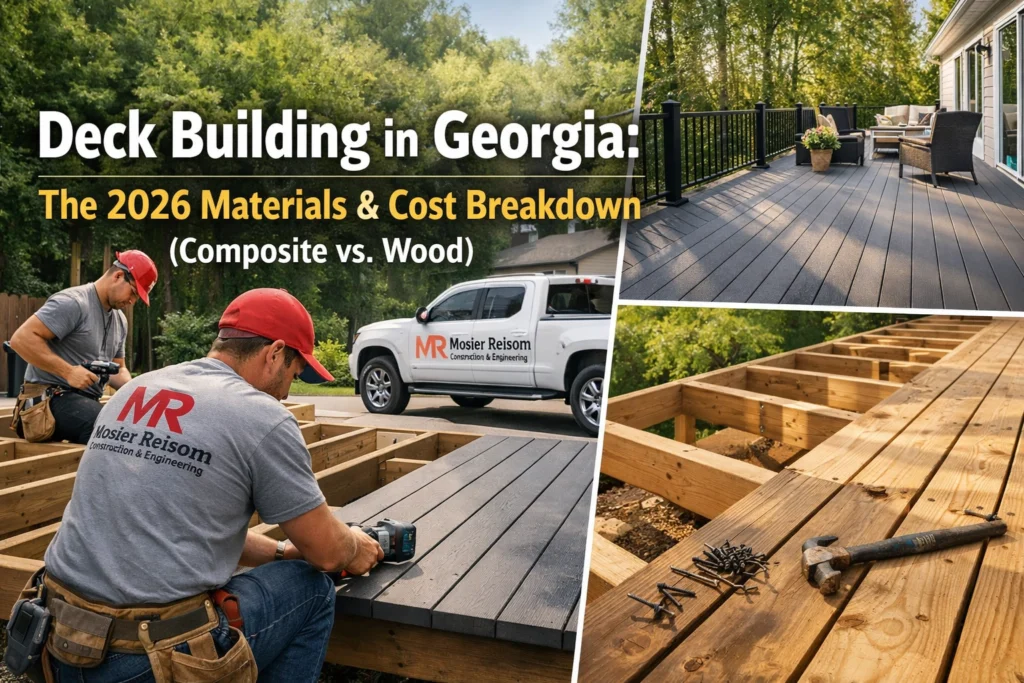
Planning a deck project in Georgia means making smart decisions about materials, costs, and construction methods that will serve your home for decades. As a deck builder serving Lawrenceville and the surrounding Gwinnett County area, we've seen firsthand how the right material choice: backed by engineering precision: transforms outdoor spaces into functional, beautiful extensions of your home. The composite versus wood decision isn't just about upfront cost; it's about understanding the complete picture of durability, maintenance, and long-term value.
In 2026, Georgia homeowners are navigating a deck market where material costs, labor rates, and building code requirements continue to evolve. Whether you're building a simple 12×16 platform or a multi-level entertainment space with built-in features, the material you choose sets the foundation for everything that follows. This guide breaks down the real numbers, real-world performance, and critical considerations that separate a well-planned deck from a costly regret.
Composite vs. Wood: The Material Showdown
Composite Decking combines wood fibers and recycled plastics to create boards that resist rot, warping, and insect damage. In Georgia's humid climate: where pressure-treated wood battles moisture and termites year-round: composite delivers consistent performance without the annual maintenance cycle. Material costs run $10–$15 per square foot for quality composite boards, with total installed costs typically landing between $30–$45 per square foot depending on the product line and installation complexity.
The upfront premium buys you decades of performance. Composite decking carries 25- to 50-year warranties, resists fading from Georgia's intense summer sun, and eliminates the need for staining or sealing. You're looking at occasional soap-and-water cleaning instead of yearly refinishing projects. For homeowners who value low-maintenance outdoor living, the math works: especially when you factor in the time and cost of maintaining wood over 15–20 years.

Pressure-Treated Wood remains the most budget-conscious choice, with material costs around $15–$25 per square foot and total installed costs in the $15–$25 per square foot range. Southern Yellow Pine, treated with preservatives to resist rot and insects, dominates the Georgia market. It's widely available, familiar to contractors, and delivers solid structural performance when properly maintained.
The trade-off is maintenance. Pressure-treated decks require cleaning, sealing, and staining every 2–3 years to prevent weathering, splintering, and moisture damage. Georgia's humidity accelerates wood degradation if you skip the maintenance schedule. Over a 20-year timeline, you'll invest hundreds of hours and thousands of dollars in upkeep: costs that composite owners avoid entirely.
Premium Hardwoods like Ipe, Cumaru, and Teak offer natural beauty and exceptional durability, with material costs ranging from $20–$35 per square foot. These dense tropical woods resist rot and insects naturally, often outlasting composite in pure longevity. But they come with their own challenges: higher upfront costs, specialized installation requirements, and the need for annual oiling to maintain color. For homeowners committed to natural aesthetics and willing to invest in premium materials, hardwoods deliver unmatched visual appeal.
Georgia Deck Cost Breakdown: What You'll Really Pay
Let's talk real numbers for a standard 20×20-foot deck (400 square feet): the most common size for Georgia homes. Using mid-range materials and professional installation, you're looking at $16,000–$24,000 total project cost. That range covers materials, labor, permits, and basic features like stairs and railings.
Labor costs account for 30–50% of your total investment in Georgia. Experienced deck contractors charge $40–$100 per hour, with most projects requiring 40–80 hours of work depending on complexity. This translates to roughly $18–$30+ per square foot for labor alone, varying by location: Atlanta metro areas run higher than suburban Gwinnett County due to demand and cost of living.

Your total installed cost breaks down like this:
- Budget-Conscious Build (Pressure-Treated Pine): $25–$35 per square foot installed | 400 sq ft deck: $10,000–$14,000
- Mid-Range Build (Quality Composite or Cedar): $35–$50 per square foot installed | 400 sq ft deck: $14,000–$20,000
- Premium Build (High-End Composite or Hardwood): $50–$70+ per square foot installed | 400 sq ft deck: $20,000–$28,000+
These numbers include basic railings, stairs to grade, and standard construction. Add built-in benches, planters, custom lighting, or multi-level designs, and costs climb proportionally. Permit fees in Georgia typically run $100–$500 depending on your municipality, with Gwinnett County requiring permits for any deck over 200 square feet or 30 inches above grade.
The $25k Deck Reality Check
A $25,000 deck is a totally normal number in 2026—especially once you move beyond the “rectangle with steps” version and start asking for something more refined, more durable, and more tailored to how you actually live outside. The reality is simple: square footage sets the baseline, but railings, stairs, framing height, and finish details are what quietly push a project into the $20k–$30k range.
Here’s what typically eats the budget fastest—without homeowners realizing it up front:
- Railing packages: Upgrading from basic wood rails to composite, aluminum, cable, or drink-rail systems can add thousands, fast, for both material and labor.
- Stairs and elevation: More height means deeper footings, more framing, more bracing, and more labor—plus stair runs that can consume a surprising amount of decking and railing.
- Framing and structural upgrades: Beam sizing, joist spacing for composites, picture framing, and blocking all add cost, but they also add stiffness, longevity, and a better finished feel.
- Site and access constraints: Tight backyards, steep grades, and long material carries aren’t “line items” homeowners expect—yet they directly affect labor hours and schedule.
- Permits and inspections: It’s not just the fee—it’s building to pass inspection with clean details, proper connectors, and code-correct execution.
If you want a quick gut-check, this is a solid rule of thumb: if your design includes premium railings, a real stair run, and mid- to high-grade decking, you should plan on $25k being a realistic middle-of-the-road target—not the “high” number. That mindset keeps decisions calm, expectations clear, and change orders to a minimum.
Durability and Maintenance: The 20-Year View
Composite decking wins the durability marathon in Georgia's climate. Quality composite resists moisture absorption, eliminates the rot and termite issues that plague wood, and maintains structural integrity for decades. Fading and scratching were concerns with early-generation composites, but 2026 products feature UV-resistant cap stocks and enhanced wear layers that keep color stable for 25+ years.
Maintenance is minimal: periodic cleaning with soap and water, occasional spot treatment for stains, and visual inspections of fasteners and structural connections. You'll never sand, stain, or seal a composite deck. For busy homeowners, this represents hundreds of hours saved over the deck's lifetime.
Wood decking requires active stewardship. Even pressure-treated lumber needs cleaning and sealing every 2–3 years to prevent moisture penetration, UV damage, and surface degradation. Skip the maintenance cycle, and you'll see cupping, checking, and splinters within 3–5 years. Georgia's humidity accelerates this process: a wood deck left untreated will show serious weathering in less than five years.
That said, properly maintained wood decks last 15–25 years, and the natural aesthetics appeal to homeowners who value authentic wood grain and warmth. The key is realistic commitment: if you'll stay on top of maintenance, wood delivers excellent value. If maintenance isn't your thing, composite eliminates the obligation.

Georgia Building Codes and Safety Considerations
Every deck in Georgia must meet the International Residential Code (IRC) as adopted by your local jurisdiction, with specific requirements for structural integrity and safety. Here's what matters for your project:
Railing Height: Decks 30 inches or more above grade require guardrails at least 36 inches tall. Balusters (the vertical pickets) must be spaced no more than 4 inches apart to prevent child entrapment: this is a non-negotiable safety standard.
Stair Requirements: Deck stairs need handrails on at least one side when you have four or more risers. Treads must be at least 10 inches deep, and risers can't exceed 7¾ inches in height. Consistent riser height throughout the staircase prevents tripping hazards and ensures code compliance.
Footings and Foundations: Georgia's frost line is minimal (typically 12 inches), but deck footings still require proper depth and bearing on undisturbed soil. Most jurisdictions require concrete footings extending 12–18 inches below grade, poured to minimum diameters based on deck size and load calculations. Coastal Georgia adds considerations for wind resistance and moisture management.
Ledger Board Attachment: When decks connect to your home, the ledger board attachment is critical. Proper flashing prevents water intrusion into your home's structure, and fasteners must meet specific spacing and type requirements. This is where engineering precision matters: improper ledger installation causes structural failure and costly water damage years down the line.
Engineering Secret: Ledger Flashing Is Where Decks Quietly Fail
Here’s the not-so-fun truth: ledger flashing is one of the most common failure points we see—and it’s the detail that a huge percentage of general contractors either rush, simplify, or treat like an afterthought. The deck can look perfect on day one and still cause hidden rot at the rim joist if the water management detail is wrong.
What we watch for—because it actually protects the house, not just the deck:
- Continuous, layered flashing (not “a little metal and caulk”): We want a shingle-style sequence that directs water out and away—because caulk is not a waterproofing strategy.
- Proper integration with the WRB/siding system: Flashing has to work with the wall’s water-resistive barrier—otherwise water gets trapped exactly where you don’t want it.
- Correct fasteners, spacing, and stand-off where required: Ledger attachment should be engineered to carry loads, while still managing moisture—both details matter, every time.
- Clean drainage path: If water can’t exit, it will sit—Georgia humidity doesn’t forgive trapped moisture.
If you remember one “engineering” takeaway from this entire guide, make it this: a deck rarely fails because the boards wore out—it fails because water was allowed to live behind the ledger.
Working with licensed contractors who understand Georgia's building codes protects your investment. Permit inspections verify proper construction at critical stages: footings, framing, and final completion. These checkpoints ensure your deck meets safety standards and won't create liability issues when you sell your home.
Your Pre-Construction Deck Planning Checklist
Before breaking ground on your Georgia deck project, work through these essential planning steps. This checklist helps you avoid costly changes mid-construction and ensures you're making informed material and design decisions from day one.
Project Planning & Budget:
- Determine your realistic budget including a 10–15% contingency for unknowns
- Decide on deck size, shape, and elevation based on your home's architecture and yard layout
- Research composite vs. wood materials and choose based on maintenance tolerance and budget
- Get 3–5 written quotes from licensed Georgia contractors for accurate cost comparison
- Verify contractors carry proper licensing, insurance, and workers' compensation coverage
Design & Features:
- Plan railing style, baluster spacing, and post locations for code compliance and aesthetics
- Design staircase locations, dimensions, and handrail requirements
- Consider built-in features (benches, planters, lighting) and their structural requirements
- Select decking board orientation (parallel vs. diagonal) and color/finish preferences
- Determine if you need shade structures, privacy screens, or future expansion areas
Site Preparation & Permits:
- Check property lines and setback requirements with your local zoning office
- Verify homeowners association (HOA) restrictions and approval processes if applicable
- Obtain building permit from your city or county before construction begins
- Mark underground utilities through Georgia 811 (call before you dig: it's the law)
- Evaluate drainage patterns and plan for proper water management around deck footings
Construction & Timeline:
- Schedule permit inspections for footings, framing, and final completion
- Confirm material delivery dates align with your contractor's schedule
- Establish weather contingency plans (Georgia summers bring afternoon thunderstorms)
- Plan for temporary restricted access to backyard during construction
- Schedule a pre-construction meeting to review expectations, timeline, and communication protocols
This checklist approach: grounded in engineering precision and real-world Georgia construction experience: prevents the frustrating surprises that derail deck projects and blow budgets.
Build Your Georgia Deck With Engineering Precision
Your deck represents a major investment in your home's outdoor living space, property value, and family enjoyment. Whether you choose composite for its minimal maintenance or wood for its natural beauty, the quality of construction matters more than the material itself. Poor installation compromises even the best materials: proper footings, structural connections, code compliance, and meticulous craftsmanship separate decks that last decades from those that require premature replacement.
At Mosier Reisom Construction & Engineering, we bring 25 years of combined experience to every deck project in Lawrenceville, Gwinnett County, and the surrounding Atlanta metro area. Our licensed, insured crews handle everything from permit applications through final inspection, building decks with the engineering precision that ensures structural integrity, safety, and long-term performance. We work with both composite and wood materials, providing honest guidance based on your specific needs, budget, and maintenance preferences.
Ready to start planning your deck project? Schedule your Free Pre-Construction Planning Consult today. We'll visit your property, discuss your vision and budget, review material options, and provide a detailed estimate with no obligation. Our consultation covers code requirements, site-specific considerations, and realistic timelines: giving you the information you need to move forward with confidence.
Contact Mosier Reisom Construction & Engineering at (770) 274-4277 or visit mosierreisom.com/deck-construction to schedule your consultation. If you prefer, you can also reach us at 1618 Pinehurst Rd. Grayson, GA 30017. Let's build the outdoor space your Georgia home deserves: with the quality, reliability, and attention to detail that comes from true engineering precision.