
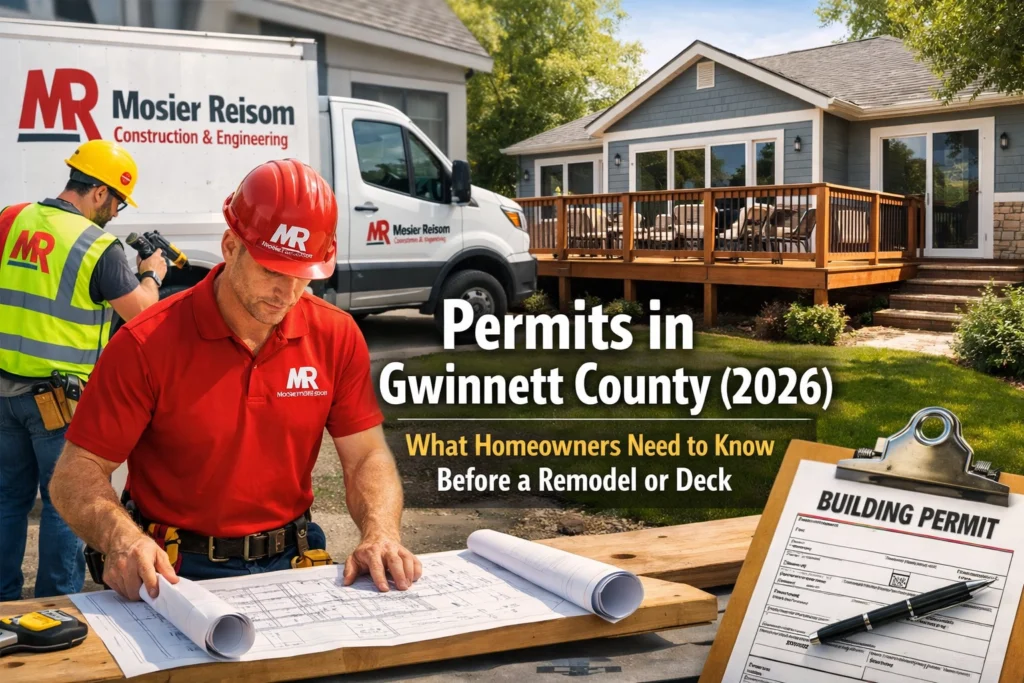
Mosier Reisom Construction & Engineering — 1618 Pinehurst Rd. Grayson, GA 30017 — 770-274-4277
If you're planning a deck addition, kitchen remodel, or bathroom upgrade in Gwinnett County, there's one critical step you absolutely cannot skip: securing the proper building permits. Many homeowners think permits are just red tape, but they're actually your protection : ensuring your project meets safety standards, protects your home's value, and keeps you legally compliant.
At Mosier Reisom Construction & Engineering, we've navigated Gwinnett County's permitting process hundreds of times over our combined 25 years of experience. We know exactly what documents you need, which inspections to expect, and how to avoid the costly delays that trap DIYers and inexperienced contractors. This guide breaks down everything you need to know about permits in 2026 : in plain English.
Why Building Permits Matter (More Than You Think)
Building permits aren't just bureaucratic paperwork. They serve three essential purposes that directly impact your wallet, your safety, and your home's future value.
Legal Protection and Insurance Coverage: If you complete a major remodel or addition without permits, your homeowner's insurance may refuse to cover damage related to that work. Even worse, when you sell your home, unpermitted work can derail your sale, force you to tear out completed projects, or significantly reduce your selling price. Mortgage lenders often require proof that all major work was permitted before approving a buyer's loan.
Safety and Code Compliance: Gwinnett County's building codes exist because they prevent electrical fires, structural failures, and plumbing disasters. The engineering precision built into these codes : covering everything from foundation depths to electrical load calculations : ensures your family's safety. Permits trigger inspections at critical stages, catching problems before they become dangerous or expensive.
Property Value Protection: Permitted work is documented work. This documentation proves to future buyers that your improvements were completed professionally, inspected by qualified officials, and built to last. Unpermitted additions or remodels often sell for 20-30% less than comparable homes with properly permitted work.

What Projects Require Permits in Gwinnett County
Gwinnett County requires a Home Building Permit for most structural changes, additions, and outdoor structures. Here's what definitely needs a permit:
Major Structural Projects:
- Additions and new rooms: Any expansion of your home's footprint, including sunrooms, bonus rooms, or garage conversions
- Deck and porch construction: Decks over 30 inches high, covered porches, and attached outdoor structures
- Foundation and structural work: Basement finishes, retaining walls over 4 feet, and any foundation repairs or modifications
- Accessory buildings: Detached garages, storage sheds over 200 square feet, and workshops
Interior Remodeling Projects:
- Kitchen remodels: When moving plumbing, electrical, or removing walls
- Bathroom renovations: Any work involving plumbing relocation, structural changes, or new fixtures
- Basement finishes: Converting unfinished space into living areas
- Load-bearing wall removal: Any structural modification requiring engineering calculations
Systems and Infrastructure:
- Electrical upgrades: New panels, circuits, or major electrical work
- HVAC installations: New systems or significant modifications to existing systems
- Plumbing work: New bathrooms, relocated fixtures, or water heater replacements
Minor cosmetic work : like painting, flooring replacement, or cabinet installation that doesn't involve structural or system changes : typically doesn't require permits. When in doubt, it's always better to ask than to assume.
The Gwinnett County Permit Application Process: Step-by-Step
Gwinnett County uses the ZIP Portal for all permit applications. The process follows a predictable sequence, and understanding each step helps you prepare properly.
Step 1: Pre-Application Preparation (1-2 weeks)
Before you even open the ZIP Portal, gather your documentation. You'll need scaled drawings of your project (typically ¼" = 1' scale), property surveys showing setback compliance, and detailed plans showing framing, electrical, and plumbing layouts. For projects involving structural elements, plans must be stamped by a licensed architect or engineer : this is where the engineering precision we apply to every project becomes essential.
Step 2: ZIP Portal Submission (1 day)
Create your account on Gwinnett County's ZIP Portal and complete the Building Permit Application. You'll provide property owner information, estimated project value, and your contractor's license number (required for all work unless you're building for your own occupancy). Upload all required documents : incomplete applications get rejected immediately, restarting your timeline.

Step 3: Plan Review Period (2-3 weeks)
County reviewers examine your plans for code compliance, checking everything from setback requirements (typically 10-25 feet from property lines) to energy efficiency standards (R-13 insulation for walls, R-30+ for ceilings). Residential projects using standard construction methods usually complete review in two weeks, but complex projects can take longer. Reviewers may request corrections or additional documentation : respond quickly to avoid extended delays.
Step 4: Permit Issuance and Payment (1-2 days)
Once approved, you'll receive notification through the ZIP Portal. Pay your permit fees online (calculated based on project value), and your permit becomes active. Print your permit placard and post it visibly at the job site : inspectors need to see it.
Step 5: Inspections and Final Approval (ongoing)
Schedule inspections at required stages: foundation before concrete pour, framing before drywall, electrical/plumbing rough-in before covering walls, and final inspection before occupancy. Each inspection must pass before proceeding to the next stage. Failed inspections require corrections and reinspection, adding time and cost to your project.
Required Documents: Your Permit Application Checklist
Missing even one required document will delay your permit by weeks. Here's your complete checklist for a typical remodel or deck project:
Core Application Documents:
- Completed Building Permit Application with accurate property information
- Property owner authorization (if you're not the owner)
- Contractor license number and proof of insurance
- Estimated project value with detailed cost breakdown
Technical Plans and Drawings:
- Site plan showing existing structures, property lines, setbacks, and proposed construction
- Foundation plans with specifications for footings, depth, and reinforcement
- Floor plans drawn to scale showing room dimensions, door/window locations, and structural elements
- Framing plans indicating load-bearing walls, beam sizes, and joist spacing
- Electrical plans showing panel location, circuit routing, outlet/switch placement, and load calculations
- Plumbing plans showing water supply routing, drain lines, fixture locations, and vent stacks
- HVAC plans with equipment specifications, ductwork routing, and efficiency calculations
Engineering and Architecture Documents:
- Architect or engineer stamp on plans for structural modifications
- Structural calculations for beams, headers, or foundation work
- Energy compliance documentation showing insulation R-values and window efficiency ratings
- Truss engineering (if applicable to your project)
Property and Zoning Documentation:
- Current property survey
- HOA approval letter (if your property is in a homeowners association)
- Proof of compliance with zoning conditions or variances
The more organized and complete your documentation, the faster your permit gets approved. At Mosier Reisom, we prepare all these documents with engineering precision, ensuring nothing gets overlooked.
Common Permit Delays and Red Flags to Avoid
Even with complete documentation, certain issues consistently delay permits in Gwinnett County. Watch for these red flags:
The Permit Loophole (That Isn't One)
Homeowners sometimes look for a “shortcut” through Gwinnett’s ZIP Portal—something that gets a plan waved through review with fewer questions and fewer back-and-forth corrections. The closest thing to a real advantage isn’t a loophole at all—it’s submitting permit-ready plans with a licensed engineer or architect stamp, because it signals the county that the structural intent has already been checked with precision.
Here’s why stamped plans often move faster in practice—especially for decks, additions, and remodels that touch structure:
- Reducing reviewer guesswork: Reviewers don’t have to interpret vague framing notes, beam sizes, or load paths—your plans and calculations spell it out clearly, which cuts down on clarifying comments.
- Preventing rejection-triggering omissions: Engineering packages typically include the details that get DIY plans kicked back—connection hardware, footing sizing, lateral loads, and specifications that match the drawings.
- Creating clean, consistent documentation: The ZIP Portal process rewards consistency—when your floor plan, framing plan, and structural notes align, you avoid the “revise and resubmit” loop that adds weeks.
This doesn’t mean stamped plans are required for every project, and it definitely doesn’t mean you can skip code requirements—what it does mean is that when your project needs structural sign-off, getting it done upfront is usually the fastest path to approval, fewer delays, and a smoother inspection phase.
Incomplete or Inaccurate Documentation: The number one cause of delays is missing information or drawings that don't match. Your electrical plan must align with your floor plan. Your structural calculations must reference the beams shown in your framing plan. Inconsistencies trigger review holds while inspectors seek clarification.
Setback Violations: Many homeowners don't realize their property has specific setback requirements : often 10-25 feet from property lines depending on zoning. A deck or addition that encroaches into required setbacks gets rejected immediately. Always confirm setbacks before designing your project.
Missing Engineering Stamps: Gwinnett County requires licensed engineer or architect stamps on plans involving structural modifications. Submitting unstamped plans for projects requiring them guarantees rejection. Don't try to skip this step : it's both required and essential for safety.

Energy Code Non-Compliance: Current energy codes require specific insulation R-values, window efficiency ratings, and HVAC efficiency standards. Plans that don't clearly demonstrate compliance face review delays while inspectors request additional documentation or calculations.
HOA Issues: If your property is in a homeowners association, Gwinnett County requires HOA approval before issuing permits. Submit your plans to your HOA early : their review process often takes 30-60 days and runs parallel to county review.
Working Before Permit Issuance: Starting construction before your permit is officially issued is illegal and triggers stop-work orders. Once a stop-work order is issued, your project faces additional scrutiny, potential fines, and extended delays. Always wait for permit approval before breaking ground.
The Inspection Process: What to Expect and When
Gwinnett County requires inspections at specific project milestones. Each inspection must pass before you proceed to the next phase : this staged approach ensures problems get caught and corrected before they're hidden behind finishes.
Foundation/Footing Inspection: Called before pouring concrete for foundations, footings, or slab work. Inspectors verify proper depth, reinforcement placement, and compliance with engineering plans. This inspection typically happens within 24 hours of your call.
Framing Inspection: Scheduled after framing is complete but before installing insulation or drywall. Inspectors check structural integrity, proper beam sizing, joist spacing, and header installation. They verify your work matches approved plans and meets code requirements for load-bearing capacity.
Rough-In Inspections (Electrical, Plumbing, HVAC): These happen after systems are installed but before walls are closed. Electrical inspectors verify proper wire sizing, circuit protection, grounding, and outlet placement. Plumbing inspectors check pipe sizing, slope, venting, and leak testing. HVAC inspectors verify proper sizing, ductwork, and ventilation.
Insulation Inspection: Called after insulation is installed but before drywall goes up. Inspectors verify proper R-values, vapor barrier installation, and coverage in all required areas : essential for energy code compliance.
Final Inspection: Scheduled when all work is complete, including finishes. Inspectors verify the completed project matches approved plans, all systems function properly, and safety features (smoke detectors, handrails, etc.) are installed correctly. Passing final inspection allows you to legally occupy or use the space.
Failed inspections require corrections and reinspection. Each reinspection adds time to your project and increases costs. Working with experienced professionals who understand inspection requirements prevents these delays.
Your Permit Prep Checklist: Before You Apply
Use this checklist before submitting your permit application to ensure you have everything ready:
Documentation Ready:
- Complete scaled drawings (¼" = 1')
- Current property survey showing setbacks
- Contractor license number and insurance proof
- Architect/engineer stamp (if structural work involved)
- Energy compliance calculations
- HOA approval letter (if applicable)
Project Details Confirmed:
- Accurate project value estimate
- Verified setback compliance
- Confirmed no zoning violations
- All structural elements properly sized and specified
- Electrical load calculations complete
- Plumbing vent and drain sizing verified
Application Accuracy:
- Owner information matches deed
- Property address is correct and complete
- All required fields filled in completely
- Documents uploaded in correct format
- Plans clearly labeled and organized
Professional Review:
- Plans reviewed by licensed professional
- All documents checked for consistency
- Backup copies saved digitally
- Timeline expectations set realistically
This checklist prevents the most common application errors that cause permit delays.
Frequently Asked Questions About Gwinnett County Permits
How long does the permit approval process take in Gwinnett County?
Standard residential projects typically receive approval within 2-3 weeks after submitting a complete application through the ZIP Portal. Complex projects involving significant structural changes or custom engineering may take 4-6 weeks. Incomplete applications or those requiring corrections add 1-2 weeks per revision cycle.
Do I need a permit for a small deck in my backyard?
Decks over 30 inches in height require a building permit in Gwinnett County. Even ground-level decks need permits if they're attached to your home or cover a significant area. It's better to call Gwinnett County Building Inspections and ask than to build without proper permits and face enforcement action later.
Can I pull my own permit, or does my contractor need to do it?
Homeowners can pull permits for work on their own primary residence that they occupy. However, if you're hiring a contractor, they must pull the permit using their license number. This protects you : it verifies they're properly licensed and insured. We handle all permitting for our clients as part of our comprehensive construction management services.
What happens if I start work without a permit?
Working without required permits is illegal and carries serious consequences. Gwinnett County can issue stop-work orders that halt your project immediately. You'll face fines, potentially doubled permit fees, and requirements to obtain after-the-fact permits (which involve more scrutiny). Your homeowner's insurance may deny claims related to unpermitted work, and you'll face disclosure requirements when selling your home that significantly reduce property value.
How much do building permits cost in Gwinnett County?
Permit fees are calculated based on your project's estimated value. Typical residential remodels range from $200-$1,500 in permit fees. New construction or major additions run higher, often $2,000-$5,000. The county's fee schedule is available on their website, but your contractor should provide accurate estimates during project planning.
Do I need an engineer's stamp for my remodel project?
Any project involving structural modifications : removing load-bearing walls, adding beams, modifying foundations, or building additions : requires plans stamped by a licensed engineer or architect in Gwinnett County. The engineering precision this provides isn't just bureaucratic requirement; it ensures your home's structural integrity and safety.

Partner With Professionals Who Know the Process
Navigating Gwinnett County's permitting process doesn't have to be stressful or confusing. At Mosier Reisom Construction & Engineering, we handle every aspect of permitting for our clients : from preparing engineered plans to scheduling inspections and managing the entire approval process.
There’s a real difference between working with a State Licensed General Contractor and hiring someone “working out of the back of their truck” : one option brings verified licensing, proper insurance, and a documented permitting process, while the other can leave you holding the liability if something goes wrong. If unpermitted work triggers a stop-work order, fails inspection, causes property damage, or results in an injury on your site, the risk often lands on the homeowner—financially, legally, and in resale complications.
Our team's 25 years of combined experience means we know exactly what Gwinnett County inspectors look for, which documentation formats they prefer, and how to structure plans for first-time approval. We apply engineering precision to every project, ensuring your remodel, addition, or deck not only meets code requirements but exceeds them.
Ready to start your project the right way? Schedule your Free Pre-Construction Planning Consult today. We'll review your project goals, explain the permitting requirements specific to your plans, and provide a clear timeline and budget that accounts for all necessary approvals. No surprises, no delays : just professional guidance from planning through final inspection.
Contact Mosier Reisom Construction & Engineering at mosierreisom.com and let's transform your vision into a properly permitted, beautifully executed reality.