
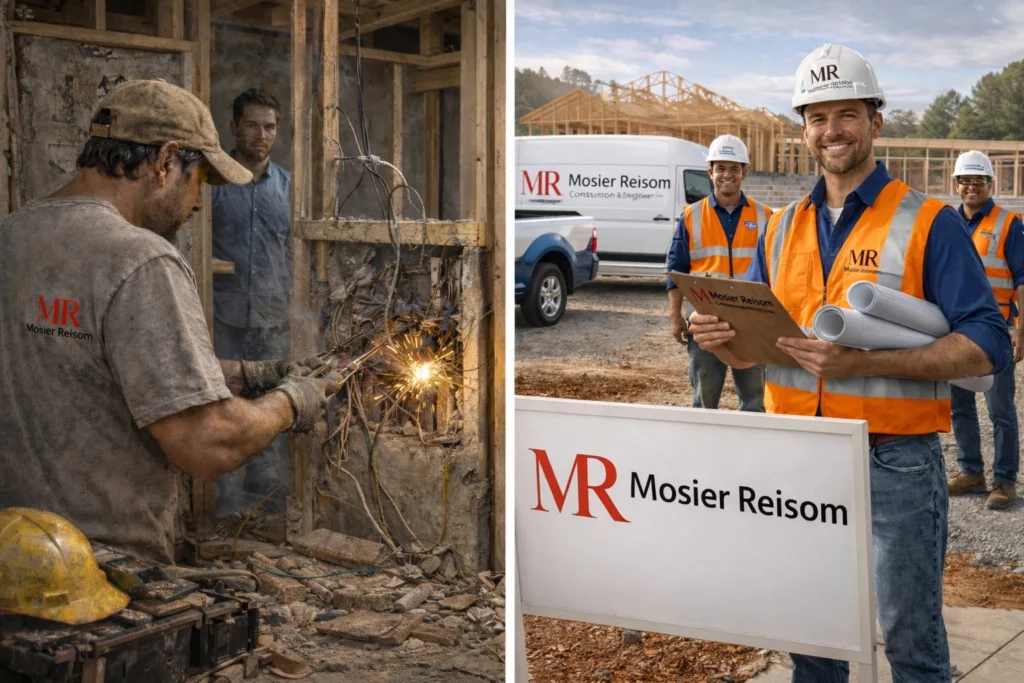
It starts the way these stories always start—an estimate that’s way lower than the rest, a promise to “knock it out fast,” and a friendly guy who says he can do it all. Then the dust settles, the drywall comes down, and suddenly you’re looking at crooked framing, mystery wiring, and a half-finished space that can’t pass inspection—because the person running the job wasn’t licensed to begin with.
Remodeling is a comprehensive investment designed to transform how your home looks, feels, and functions—and at Mosier Reisom Construction & Engineering, we go beyond “basic labor” to deliver a seamless, design-build experience built around precision, protection, and accountability. New Home Construction is the same kind of decision—just on a larger scale—because building a custom home from the ground up demands disciplined planning, code-level execution, and a team that can carry the vision from concept to closeout. When our State Licensed General Contractor leads your project—backed by a Master’s in Engineering—every detail is planned with care and executed to code, so you get a refined result instead of a costly redo.
State Licensing: The Line Between “Looks Fine” and “Passes Inspection”

A state-licensed general contractor in Georgia has met specific requirements set by the Georgia State Licensing Board for Residential and General Contractors. This isn't a simple registration process: it requires demonstrating technical knowledge, financial responsibility, and adherence to professional standards. Licensed contractors must:
- Pass comprehensive examinations covering building codes, safety regulations, business practices, and construction law
- Maintain liability insurance and workers' compensation coverage to protect clients and employees
- Submit to background checks and demonstrate financial stability
- Complete continuing education to stay current with code changes and industry best practices
- Operate under state oversight with accountability mechanisms for complaints and violations
An unlicensed worker: the person offering services from their pickup truck: has bypassed all of these requirements. They might have practical skills, but they lack the verified credentials, insurance coverage, and legal accountability that protect homeowners throughout the construction process.
The Contract Trap: How Unlicensed Work Turns Into a Legal and Financial Mess
Georgia strengthened its contractor licensing laws in 2008 specifically to protect consumers, and the consequences for both parties are severe. Under Georgia law, any contract entered into with an unlicensed contractor for work requiring a license is "unenforceable in law or in equity." This creates a dangerous situation for homeowners.
In the landmark case Saks Management and Associates, LLC v. Sung General Contracting, Inc., the Georgia Court of Appeals ruled that an unlicensed contractor could not recover $680,000 on a $2.3 million contract: even though the work was substantially completed. While this might seem like a victory for the property owner, it illustrates the volatility of these arrangements. Unlicensed contractors cannot legally enforce payment, which means they may:
- Demand large deposits upfront because they have no legal recourse for collection
- Abandon projects mid-construction if payment disputes arise
- Place liens on your property despite their unlicensed status
- Engage in aggressive collection tactics outside legal channels
The asymmetry works against homeowners too. While an unlicensed contractor cannot sue for payment, the property owner can still be sued for breach of contract, damages, or injuries that occur on the property. You lose the protections that come with a legally enforceable contract and professional standards.
Code Violations and Safety Hazards: The “Looks Good” Work That Fails Later

Building codes exist to ensure structural integrity, electrical safety, plumbing functionality, and fire protection—yet unlicensed work is where we most often see “looks fine today” decisions that become expensive problems tomorrow. Licensed general contractors are trained in these codes and held accountable for compliance, while unlicensed workers often lack that framework—or cut corners to hit an unrealistically low price and a rushed timeline.
The risks include:
- Structural failures: Improperly supported walls, sagging floors, or compromised foundations that threaten your home's integrity
- Electrical hazards: Faulty wiring, overloaded circuits, and improper grounding that create fire risks and violate the National Electrical Code
- Plumbing disasters: Leaks behind walls, inadequate venting, cross-connections that contaminate drinking water, and code violations that surface during inspections or resale
- HVAC inefficiencies: Improperly sized systems, inadequate ductwork, and ventilation problems that increase utility bills and reduce comfort
In the case Restor-It, Inc. v. Beck, a specialty contractor performing kitchen and bath work was unable to enforce its contract after completing less than 20% electrical and plumbing work without proper credentials. This demonstrates that even small amounts of licensed work performed without certification can void contracts—and more importantly, it highlights how unlicensed work in critical systems puts homeowners at risk.
When Mosier Reisom Construction & Engineering handles your kitchen remodeling or bathroom remodeling project, our design-build approach keeps planning and execution under one roof—so details don’t get missed, budgets don’t spiral, and quality doesn’t get “value-engineered” into failure. The same disciplined approach applies to New Home Construction—when we’re building a custom home from the ground up, we coordinate design, engineering, and field execution as one team, which keeps your timeline tighter and your decisions clearer. And because our leadership brings a Master’s in Engineering, your project benefits from technical decision-making that protects both performance and resale value, with precision.
The Insurance and Liability Gap: The Part Nobody Thinks About Until It’s Too Late

Perhaps the most dangerous aspect of hiring unlicensed contractors is the insurance void they create. Licensed contractors must carry general liability insurance and workers' compensation coverage. Unlicensed workers typically have neither.
Here's what this means for your home in Gwinnett and surrounding areas:
Property damage becomes your financial burden. If an unlicensed worker damages your plumbing, electrical system, or structural components during demolition or construction, you have limited recourse. They won't have liability insurance to cover repairs, and collecting from them personally is often impossible.
Worker injuries expose you to massive liability. If someone working on your property gets injured and they're not covered by workers' compensation insurance, they can sue you as the property owner. Medical bills, lost wages, and legal fees can quickly exceed $100,000: far more than any savings you gained by hiring cheap labor.
Your homeowner's insurance may not cover unlicensed work. Many homeowner's insurance policies explicitly exclude coverage for damages resulting from unlicensed contractors or work performed without proper permits. If a kitchen fire starts due to faulty electrical work by an unlicensed contractor, your insurer may deny the claim entirely.
Bonding protects against fraud and abandonment. Licensed contractors often carry surety bonds that protect homeowners if the contractor fails to complete the work, uses substandard materials, or violates contract terms. Unlicensed workers have no such protection, leaving you vulnerable to lost deposits and unfinished projects.
Mosier Reisom Construction & Engineering maintains comprehensive insurance coverage and bonding as part of our commitment to client protection. This isn't just a legal requirement: it's a fundamental aspect of professional responsibility that separates legitimate contractors from unlicensed operators.
Spot the Difference Fast: Licensed Pro vs. “Guy With a Truck”
The "guy in the truck" often presents well and offers competitive pricing, making it difficult for homeowners to distinguish between legitimate professionals and unlicensed operators. Here are the red flags to watch for:
Warning signs of unlicensed work:
- Reluctance to provide a physical business address beyond a P.O. box or cell phone
- Requests for large cash deposits or full payment upfront
- Inability or unwillingness to provide proof of licensing, insurance certificates, or references
- Pressure to avoid permits because they're "unnecessary" or "just add cost"
- Quotes that seem dramatically lower than other estimates without clear explanation
- Generic business names without verifiable online presence or reviews
What licensed professionals provide:
- Georgia contractor license number that you can verify through the state licensing board
- Certificates of insurance showing current general liability and workers' compensation coverage
- Detailed written contracts specifying scope of work, materials, timeline, payment schedule, and warranties
- Willingness to obtain proper permits and schedule inspections
- Physical office location and established business presence
- Professional references and portfolio of completed projects
At Mosier Reisom Construction & Engineering, transparency is part of our professional standard—and our design-build process is built to keep decisions clear, documentation complete, and execution consistent. As a LEED Green Associate and State Licensed General Contractor with 25 years of experience serving Gwinnett and surrounding communities, we provide complete documentation, clear communication, and accountability at every stage of your project.
Credentials Aren’t “Nice to Have”—They’re Your Safety Net

When you're investing tens of thousands of dollars in a home remodel or deck construction project, the credentials and experience of your contractor directly impact the outcome. The difference between licensed and unlicensed work extends beyond legal compliance: it's about the depth of knowledge, problem-solving capability, and commitment to excellence that comes with professional training and certification.
Mosier Reisom Construction & Engineering brings a unique combination of credentials to every project in Lawrenceville, Gwinnett County, and the surrounding 25-mile radius—and because we operate as a seamless design-build team, what gets designed is what gets built, with precision:
- 25 years of construction experience across residential and commercial projects
- Master's degree in Engineering providing technical expertise in structural design, systems integration, and problem-solving
- Master's degree in Construction Management ensuring projects are completed on time, within budget, and to specification
- LEED Green Associate certification demonstrating expertise in sustainable building practices and energy efficiency
- State Licensed General Contractor with full compliance with Georgia licensing requirements, insurance, and bonding
This combination of education, certification, and experience means your project benefits from engineering precision, construction management best practices, and accountability to professional standards. It's the difference between hoping the work is done correctly and knowing it meets verified professional benchmarks.
The Bottom Line: Choose the Remodel Story You Want to Tell
The temptation to save money by hiring unlicensed contractors is understandable, particularly in today's economy. But the risks: legal vulnerability, code violations, insurance gaps, and safety hazards: far outweigh any short-term savings. Georgia law treats unlicensed contracting as a serious matter precisely because of the consumer protection issues and public safety concerns it creates.
Your home is likely your largest investment, and any remodeling project should enhance its value, safety, and functionality. Working with a licensed professional ensures that every aspect of your project meets legal requirements, building codes, and industry standards. It provides recourse if problems arise, insurance protection if accidents occur, and confidence that the work will pass inspection and add value to your home.
For homeowners in Gwinnett and the surrounding areas considering kitchen remodels, bathroom renovations, deck additions, New Home Construction, or comprehensive home improvements, the choice is clear. Licensed professionals bring verified credentials, legal accountability, insurance protection, and technical expertise that unlicensed workers simply cannot match.
Contact Mosier Reisom Construction & Engineering to discuss your project with a State Licensed General Contractor who brings 25 years of experience, advanced degrees in engineering and construction management, and a commitment to quality, safety, and professional excellence. Your home deserves better than the back of a truck: it deserves the precision and protection that only licensed professionals can provide.