
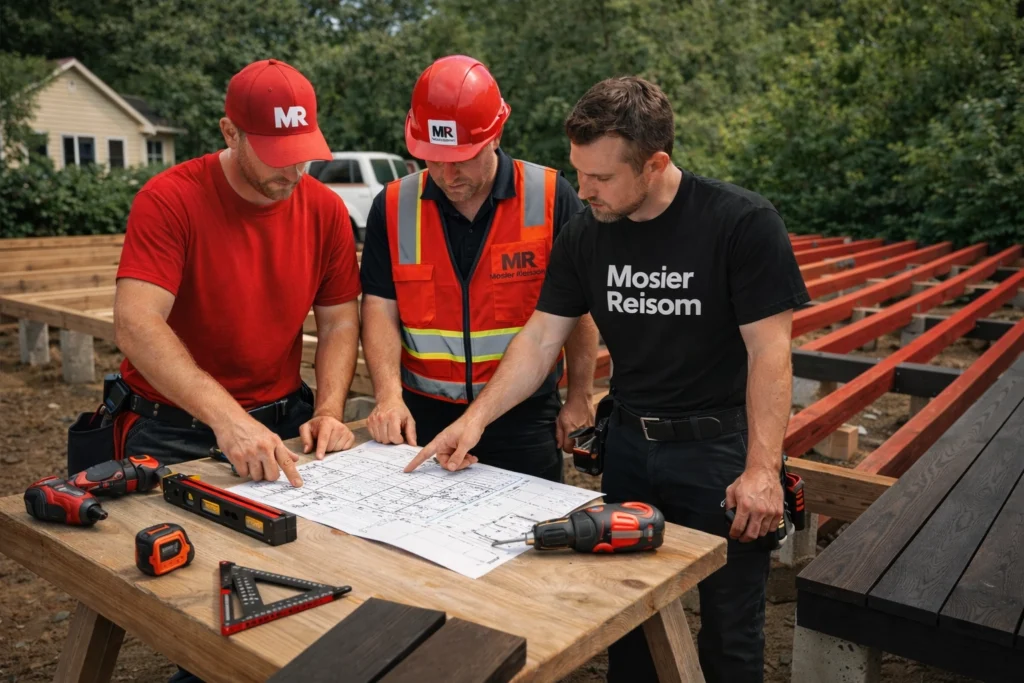
If you're planning a deck in the Lawrenceville or greater Gwinnett County area, you're not just picking out boards and paint colors. You're making structural decisions that will determine whether your investment lasts a decade : or needs major repairs in five years. Georgia's heat, humidity, and seasonal rain cycles are relentless on outdoor structures, and the difference between a deck that holds up and one that doesn't comes down to three things: material choice, engineering precision, and proper installation details.
At Mosier Reisom Construction & Engineering, we approach deck projects the same way we approach custom homes and complex remodels : with structural rigor and an understanding of how materials perform under real-world conditions. Here's what homeowners need to know before they commit to a deck build.
PT Wood vs. Composite: The Longevity and Cost Reality
Let's get the first question out of the way: pressure-treated (PT) wood or composite decking? Both are approved under Georgia's prescriptive deck standards, but they behave very differently over time in our climate.
Pressure-Treated Wood: The Traditional Option
PT wood (typically Southern Yellow Pine treated with copper-based preservatives) is still the most common framing and decking material in Georgia. It's cost-effective upfront, widely available, and when installed correctly, can deliver 15–20 years of service life.
Advantages:
- Lower initial cost : roughly 40–50% less expensive than composite per square foot
- Easy to work with : cuts, fastens, and repairs like standard lumber
- Structural integrity : maintains load-bearing strength when kept dry and properly supported
Challenges in Georgia:
- Moisture cycling : our humid summers and wet winters cause wood to expand, contract, and eventually check (crack along the grain)
- Maintenance demands : requires annual cleaning and re-staining/sealing every 2–3 years to prevent rot and UV degradation
- Deck board wear : high-traffic areas will show splintering and surface degradation after 10–12 years, even with good maintenance
Bottom line: PT wood works well for homeowners willing to commit to routine upkeep and who prioritize budget flexibility. For framing (joists, beams, posts), PT lumber is the industry standard regardless of what decking material you choose.

Composite Decking: The Low-Maintenance Alternative
Composite decking : made from wood fibers and polymer resins : has evolved significantly in the last decade. Modern composite products resist moisture, fading, and insect damage far better than first-generation materials.
Advantages:
- Minimal maintenance : no staining, sealing, or sanding required; periodic washing is typically all that's needed
- Longevity : quality composite products carry 25–30 year warranties and routinely outlast PT wood in Georgia's climate
- Consistent appearance : no warping, cupping, or splitting; color stays more stable over time
Challenges:
- Higher upfront cost : typically $8–$12 per square foot installed vs. $4–$6 for PT wood
- Heat retention : composite surfaces can get significantly hotter than wood in direct sunlight (a real concern for barefoot traffic in July)
- Structural limitations : composite is a decking material only; all framing must still be PT or treated lumber, per Georgia code
Bottom line: Composite makes sense for clients who value long-term cost savings (reduced labor and materials for maintenance) and want a deck that looks good with minimal intervention. It's particularly suited to shaded areas or covered decks where heat buildup is less of an issue.
The Hybrid Approach
Many of our projects use a PT wood substructure with composite decking. This gives you the structural reliability of treated lumber where it matters (hidden framing) and the low-maintenance performance of composite where you see and walk on it daily.
Why Footings Matter: Engineering the Load
Here's where a lot of DIY and budget-build decks fail: footings are treated as an afterthought instead of the foundation of the entire system. A deck is a cantilevered structure transferring thousands of pounds of live load (people, furniture, snow, water) and dead load (the structure itself) into the ground. If your footings aren't sized, placed, and installed correctly, everything above them is compromised.
Georgia Code Minimums (and Why We Exceed Them)
Georgia's prescriptive deck standards require:
- Footing depth: Minimum 12 inches below grade
- Bearing verification: Footings must rest on solid, undisturbed soil (not fill or loose material)
- Proximity rule: Footings within 5 feet of an existing foundation must be set at the same depth as that foundation to prevent differential settlement
- Hardware: All post anchors must be galvanized to resist corrosion
These are minimums. On our projects, we typically spec deeper footings (16–24 inches) and wider diameter concrete piers to account for Georgia's red clay soil conditions, which expand and contract with moisture changes. Undersized footings in clay can lead to frost heave in winter or settling in wet seasons : both of which cause structural movement, sagging joists, and fastener failure.

Load Distribution and Span Calculations
This is where the "engineering" part of our name comes into play. Deck framing isn't guesswork. Every joist span, beam size, and post spacing is calculated based on:
- Live load assumptions (40 psf for residential decks per IRC)
- Dead load (weight of decking, framing, and railings)
- Cantilever limits (how far joists can safely extend beyond the beam)
- Lateral bracing (preventing side-to-side racking)
We see a lot of decks in Gwinnett County that were built with joists spanning too far or posts spaced too wide. The result? Bouncy decks, sagging boards, and premature fastener pullout. Proper engineering eliminates those issues before the first board is cut.
Flashing and Ledger Safety: The Hidden Failure Point
If there's one area where deck failures happen most often, it's the ledger board attachment : the connection between the deck framing and the house. This connection carries half the deck's load, and if it's not flashed and fastened correctly, you're looking at water intrusion, rot, and potential structural collapse.
Why Flashing is Non-Negotiable
Georgia gets an average of 50+ inches of rain per year. When a deck ledger is bolted directly to a house wall without proper flashing, water runs down the siding, gets trapped behind the ledger, and soaks into the rim joist and sill plate. Over time, this creates hidden rot that weakens the attachment : often unnoticed until the deck pulls away from the house.
Proper ledger installation includes:
- Flashing membrane behind and over the ledger to direct water away from the house structure
- Mechanical fasteners (galvanized lag screws or through-bolts, never nails) at code-specified spacing
- Clearance gaps to allow airflow and drainage between the ledger and house sheathing
- Inspection access so future homeowners (or inspectors) can verify the connection integrity
We've rebuilt dozens of decks where the original ledger was installed with construction adhesive and a few nails : a recipe for failure in any climate, but especially in Georgia's wet conditions.
Deck Railings and Code: Safety You Can't Skip
Georgia follows the International Residential Code (IRC) for deck railings, and the requirements are specific:
- Height: 36 inches minimum from the deck surface to the top of the rail
- Baluster spacing: Maximum 4 inches between balusters (the "sphere test" : a 4-inch ball can't pass through)
- Load rating: Rails must withstand 200 pounds of outward force at any point
We also recommend:
- Graspable handrails on stairs (different from guardrails) with 1.25–2 inch diameter profiles
- Post-to-joist connections using through-bolts or structural screws, not just surface-mounted brackets
- Rot-resistant materials for post sleeves and base trim, even on composite rail systems
Railings aren't just about passing inspection : they're life-safety components. A failed railing can result in serious injury, and liability issues if it's determined the installation didn't meet code.
Building for 10–20 Years: What It Takes
A properly engineered and constructed deck in Georgia should deliver 15–20+ years of service with routine maintenance (for wood) or minimal intervention (for composite). Here's what separates a long-lasting deck from one that needs major repairs in under a decade:
Material Selection:
- Use the right grade and treatment level (0.40 or higher retention for ground contact)
- Choose fasteners rated for treated lumber (stainless steel or coated)
- Spec joist tape or flashing on top of all framing to prevent water pooling
Engineering Precision:
- Design for actual load conditions, not just code minimums
- Account for Georgia soil behavior and seasonal movement
- Verify all connections with structural fasteners, not reliance on nails alone
Installation Details:
- Proper flashing and drainage paths to keep water moving away from critical connections
- Adequate ventilation below the deck to prevent moisture buildup
- Regular inspection points to catch issues before they become structural problems

Ready to Build It Right?
At Mosier Reisom Construction & Engineering, we treat every deck project as a structural system : not just a weekend carpentry job. Whether you're leaning toward PT wood for budget flexibility or composite for long-term performance, we'll walk you through the engineering, material tradeoffs, and installation details that matter in Georgia's climate.
Get a professional deck estimate and material consultation. Call us at 770-274-4277 or visit mosierreisom.com/deck-construction to schedule your on-site assessment. We'll give you a Budget + Schedule Reality Check : no fluff, just the structural facts you need to make an informed decision.