
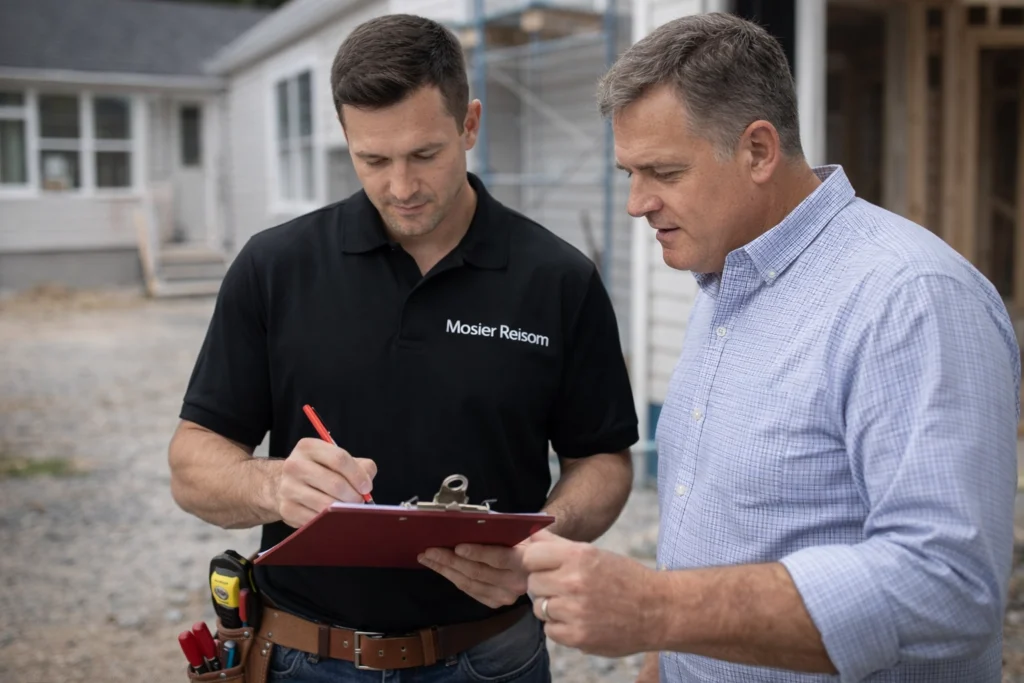
Choosing a contractor for your home project shouldn't feel like gambling with your life savings. Yet every year, homeowners in Gwinnett County hire contractors based on a low bid and a handshake: only to discover halfway through the job that they've hired someone who's uninsured, unlicensed, or in way over their head. The "truck and a ladder" contractor might save you 20% upfront, but that savings evaporates fast when permits get rejected, work fails inspection, or worse: someone gets injured on your property and you're holding the liability.
The good news? You can spot a professional contractor from a pretender in about 15 minutes if you know the right questions to ask. These aren't gotcha questions: they're baseline standards that separate legitimate construction companies from fly-by-night operations. A real contractor won't hesitate to answer them. In fact, they'll respect you more for asking.
Here are the 12 questions that reveal quality, competence, and accountability before you sign anything.
1. "Can I see your Georgia Contractor License number?"
This is question number one for a reason. In Georgia, anyone doing residential contracting work over $2,500 must hold a state license issued by the Georgia Secretary of State. This isn't a suggestion: it's the law. A licensed contractor has passed a comprehensive exam, proven financial solvency (minimum $150,000 net worth), and maintained bonding and insurance requirements.
Ask for the license number and verify it yourself at sos.ga.gov. Check the status, the issue date, and any disciplinary actions. If a contractor hesitates or offers excuses ("my license is being renewed," "I work under my brother's license"), walk away. Unlicensed contractors can't pull permits legally, can't offer you legal recourse if something goes wrong, and put your project at serious risk.
Red flag: "I don't need a license for this type of work." Unless it's truly minor repairs under $2,500, this is false.
2. "What's your General Liability insurance coverage amount?"
General Liability insurance protects you if the contractor damages your property during the job: a broken window, a cracked foundation, a flooded basement. It also covers third-party injuries (like a neighbor tripping over materials left on your driveway).
Ask to see the Certificate of Insurance (COI) and confirm it's current. Professional contractors carry at least $1 million in coverage, and many carry $2 million. The certificate should list your address as the job site and show coverage dates that extend through your project timeline.
Red flag: "I'm insured, trust me." Trust nothing: verify everything. If they can't produce a current COI within 24 hours, assume they're uninsured.

3. "Do you carry Workers' Compensation insurance?"
This is where homeowners get blindsided. If a contractor's crew member gets hurt on your property and the contractor doesn't carry Workers' Comp, guess who the injured worker can sue? You. Your homeowner's insurance might cover it, but more often, you're exposed personally.
Georgia law requires Workers' Comp for any contractor with three or more employees. But even sole proprietors should carry it if they use subcontractors. Ask for proof: a current Workers' Comp certificate that lists active coverage. No certificate? No contract.
Red flag: "I only use subs, so I don't need Workers' Comp." That's often untrue: if those subs aren't independently insured and licensed, you're still exposed.
4. "What project management software or system do you use?"
This question separates pros from pretenders fast. Professional contractors use systems to track schedules, budgets, change orders, selections, and communication. Tools like Buildertrend, CoConstruct, or even well-organized shared drives and spreadsheets show that a contractor runs a business, not a side hustle.
If the answer is "I keep everything in my head" or "we'll just text," expect chaos. You'll have no clear timeline, no documentation of what was agreed to, and no visibility into where your money is going.
What to listen for: Specifics. "We use [software name], and you'll get login credentials so you can see the schedule, approve selections, and track invoicing in real time."
5. "How do you handle communication and project updates?"
Ghosting contractors are a top homeowner complaint. You need to know upfront: How often will you hear from them? Who's your point of contact? What's the response time for questions?
Professional contractors establish communication norms: weekly update calls, daily text check-ins during active phases, a project portal for document sharing. They assign a dedicated project manager or lead carpenter who's your go-to person, not the owner who's juggling six jobs.
Red flag: "Just call me whenever." That's not a system: that's a recipe for frustration.
6. "Do you have engineering capability in-house or on retainer?"
Here's where you separate general contractors from design-build firms with engineering precision. If your project involves structural changes, complex drainage, foundation work, or load-bearing modifications, you need engineers: not a framer with a good guess.
At Mosier Reisom Construction & Engineering, engineering isn't an add-on: it's built into our process from day one. That means structural calculations, stamped drawings, and buildable plans that pass inspections the first time. It also means fewer surprises, fewer change orders, and fewer "we didn't realize that wall was load-bearing" moments.
Ask: "Do you use a structural engineer for projects like mine?" If they say "only if required by permit," that's not the same as proactive engineering oversight.

7. "Can you show me three similar projects you've completed in the last 12 months?"
Photos prove capability. Any contractor can show you their best work from five years ago. You want to see recent, relevant projects: ideally in your neighborhood, at a similar budget, and with comparable scope.
Look for consistency in finish quality, clean job sites, and attention to detail. Bonus: ask if you can speak to those homeowners. A contractor confident in their work will gladly connect you with past clients.
Red flag: "I don't have photos, but I can describe the work." In 2026, every contractor has a phone with a camera. No photos = no proof.
8. "How do you handle permits and inspections?"
This is where the "truck and ladder" guys get exposed. Pulling permits costs money and takes time, so unlicensed or inexperienced contractors skip them: putting you at massive risk. Unpermitted work can tank your home's resale value, void your insurance, and trigger expensive remediation down the road.
Professional contractors pull permits as part of the process. They coordinate inspections, they fix anything the inspector flags, and they ensure your final Certificate of Occupancy (if applicable) is issued. They also understand local codes in Gwinnett County: setbacks, zoning, HOA requirements: and build them into the plan upfront.
What to listen for: "We handle all permitting. It's included in our contract, and we'll schedule inspections to keep the job moving."
Learn more about Gwinnett County permit requirements here.
9. "What's your typical project timeline, and what could delay it?"
Honest contractors give realistic timelines: and explain what could slow things down. Permits, material lead times, weather, inspection delays, and homeowner selection delays are all normal. What's not normal is a contractor who promises a kitchen remodel in two weeks or a custom deck in three days.
Ask for a written timeline with milestones. Then ask: "What's the most common reason your projects run over schedule?" Their answer will tell you if they plan proactively or react to chaos.
Red flag: "We'll be done in [unrealistically short time]." If it sounds too fast, it is.
10. "How do you price projects: fixed bid, cost-plus, or time and materials?"
Pricing structure reveals how a contractor operates. Fixed-price contracts give you cost certainty but require detailed scope upfront. Cost-plus pricing (contractor's costs + markup) offers flexibility but requires trust and transparency. Time-and-materials works for smaller projects but can spiral without caps.
There's no "right" answer, but you need to understand what you're signing. Ask: "What happens if we encounter hidden conditions or make changes mid-project?" The answer should be clear, documented, and tied to a change-order process: not vague or dismissive.
11. "What's included in your contract, and what's considered an 'allowance'?"
Allowances are placeholders for items you'll select later: tile, fixtures, appliances, etc. But vague allowances are where budgets explode. A professional contract breaks down allowances by category and gives realistic ranges based on your style and quality tier.
Ask to see a sample contract (with another client's info redacted). Look for detail: scope of work, payment schedule, start/end dates, warranty terms, dispute resolution. If the "contract" is a one-page proposal with a total and a handshake, run.
12. "What warranty do you offer, and how do you handle post-project issues?"
Reputable contractors stand behind their work: typically one year for workmanship, longer for structural elements. But the warranty is only as good as the contractor's ability to honor it. Ask: "If I have an issue six months after completion, what's the process?"
You want a clear answer, a local phone number, and confidence that they'll still be in business next year. Fly-by-night operators don't offer warranties because they won't be around to honor them.

The Bottom Line: Vet Hard, Build Confidently
These 12 questions aren't about being difficult: they're about being smart. A professional contractor with nothing to hide will answer every one of them clearly, quickly, and with documentation to back it up. If a contractor gets defensive, vague, or dismissive, that's your signal to keep looking.
At Mosier Reisom Construction & Engineering, we welcome these questions because we have answers: state license, $2M liability coverage, in-house engineering, transparent contracts, and a track record of projects throughout Gwinnett County that speak for themselves. Our team wears branded shirts, drives marked trucks, and shows up with detailed project plans: because professionalism isn't optional, it's standard.
Ready to work with a contractor who checks every box? Call us at 770-274-4277 for a Budget + Schedule Reality Check. We'll answer your questions, walk your site, and give you a clear path forward: no pressure, no runaround, just straight talk from a team that's been doing this right since day one.